

What's in Your Handbag? Hen Party Game and Points List
What's in Your Handbag is a points game using things guests have brought with them. Give each player the same item list, let them check their own belongings and add the points for each match. The highest score wins.

It is also called What's in Your Bag or What's in Your Purse. You can include pockets, backpacks and clutch bags too; nobody needs to bring a particular kind of bag or buy anything for the game.
Here is a complete DIY version with 30 items, a score out of 90 and rules that avoid the usual arguments about borrowing and counting the same object twice.
What you need
- One copy of the points list per player or team, or a large shared list.
- Pens and somewhere to write totals.
- The belongings guests already have with them.
- An optional small prize.
Allow about 10–15 minutes as a planning guide, including the explanation and a short reveal. Guests can stay seated. Ask the venue before using tables that are set for food service, and keep personal items away from plates and shared food.
How to play
- Explain that bags and pockets count, but only belongings already with a player when the round begins.
- Hand out the same list to everyone. Let guests read it before starting and explain the counting rules below.
- Give players a few minutes to mark the items they have. Nobody searches another person's bag.
- Add the points in each group, then add the three subtotals.
- Invite guests to share a funny or surprising find if they want to. Showing belongings is optional.
- Announce the highest score. Share the win if players are tied, or use the tie-breaker below.
Guests can tick their own lists honestly. Do not ask people to empty their bags, reveal medical items, unlock phones or show identifying details on receipts or cards.
The counting rules
Use these rules for the list below:
- Each listed item scores once, however many copies you carry. Three pens still earn one point for “pen”.
- One physical object can score against only one row. A phone case that holds cards cannot also become a separate wallet unless there is a separate wallet.
- Either option in a combined row earns that row's points, not points for both. Glasses and sunglasses together still score once on their row.
- Borrowing, fetching items from a car and buying something during the round do not count.
- Only physical items count in this version. A photograph on a phone is not a printed photograph, and a shopping app is not a reusable shopping bag.
For team play, use one shared list and count each row once across the whole team. Keep teams the same size where possible.
The 30-item points list
These are suggested scores for this DIY version, not official rules or a reproduction of any boxed game's card. The five-point group adds variety; the items will not be equally unusual in every group.
One point each
| Item | Points | Tick if you have it |
|---|---|---|
| Phone | 1 | ___ |
| Separate wallet or purse | 1 | ___ |
| Keys | 1 | ___ |
| Pen | 1 | ___ |
| Tissues | 1 | ___ |
| Lip balm or lipstick | 1 | ___ |
| Hair tie | 1 | ___ |
| Glasses or sunglasses | 1 | ___ |
| Reusable shopping bag | 1 | ___ |
| Hand sanitiser | 1 | ___ |
One-point subtotal: ______ / 10
Three points each
| Item | Points | Tick if you have it |
|---|---|---|
| Charging cable | 3 | ___ |
| Hand cream | 3 | ___ |
| Compact mirror | 3 | ___ |
| Plaster | 3 | ___ |
| Hairbrush or comb | 3 | ___ |
| Folded umbrella | 3 | ___ |
| Notebook | 3 | ___ |
| Separate case for glasses | 3 | ___ |
| Reusable water bottle | 3 | ___ |
| Headphones or earbuds | 3 | ___ |
Three-point subtotal: ______ / 30
Five points each
| Item | Points | Tick if you have it |
|---|---|---|
| Printed photograph | 5 | ___ |
| Sewing kit | 5 | ___ |
| Safety pin | 5 | ___ |
| Bookmark | 5 | ___ |
| Reusable cutlery | 5 | ___ |
| Lint roller | 5 | ___ |
| Pack of playing cards | 5 | ___ |
| Paper map | 5 | ___ |
| Spare pair of socks | 5 | ___ |
| Postage stamp | 5 | ___ |
Five-point subtotal: ______ / 50
Player or team: ____________________
Final total: ______ + ______ + ______ = ______ / 90
You can copy the tables into a document to make your own game sheet. If you remove an item, remove it for everybody and update the maximum score.
A worked scoring example
Sam has a phone, wallet, keys, pen, tissues and lip balm: six points from the first group.
They also have a charging cable, umbrella, water bottle and earbuds: 12 points from the second group. A bookmark and a stamp add 10 points from the last group.
The total is 6 + 12 + 10 = 28 points. A second pen adds nothing. If the stamp is inside a notebook, the two can count separately because they are two separate objects.
If the only thing being called a “sewing kit” is one loose safety pin, score the pin row only. A separate kit containing other sewing supplies is a different object. Agree this before marking.
A tie-breaker without another bag search
Before starting, choose a number between 1 and 100 and write it on a folded piece of paper. If players tie, ask them to write one guess each without seeing the number. The closest guess wins, whether it is higher or lower.
If the guesses are equally close, share the win. Keeping a joint winner is simpler than inventing increasingly personal things to search for.
If some guests have not brought a bag
Pockets count in this version. Someone without many belongings can join a partner, read out the list or keep score if they prefer.
For a group with very different amounts of luggage, play in equal-sized teams from the start. Do not make the person with a small evening bag compete against a team pooling four weekend bags. Alternatively, drop the competitive score and use the list as a short conversation starter.
There is no requirement to own make-up, carry cash or show a particular brand. Adapt the list to the actual group, keeping the same list for every player.
At a restaurant or on a hen weekend
At a restaurant, play between courses with the staff's agreement. Guests can check their belongings discreetly on their laps rather than covering the table. Avoid racing to pull out items or interrupting service.
On a weekend away, agree that only the bag or pockets with each player count, not every suitcase in the accommodation. Tell guests the rule when the game begins rather than sending them shopping for bonus items beforehand.
For a contrasting activity afterwards, choose a quiz or drawing round from our hen party games guide. The hen party accessories checklist can help you organise the shared supplies for the wider event.
Choose a ready-printed game pack
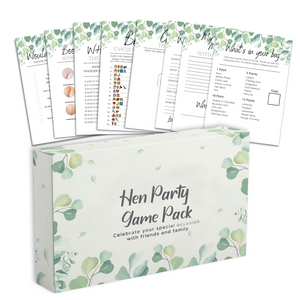
Both our standard eight-game hen party bundle and Rose Gold eight-game bundle list What's in Your Bag among their games. Select the guest-pack option for your group and check the full contents before ordering.
The 30-item list and 90-point system above are a separate DIY version. If you buy a pack, follow the item list and scoring on its supplied cards rather than mixing the two sets of rules.
Common questions
Do guests have to show every item
No. This version uses self-marking. People may share a find, but nobody needs to display private belongings or hand their bag to the host.
Can you include digital items
You can design a digital-friendly version, but agree it before the game and give everyone the same rules. The list above counts physical objects only and never requires anyone to open private messages or accounts.
Are there minus points
Not in this version. Every matched row adds its printed value. There are no deductions for having a small bag or choosing not to show an item.
Can the bride join in
Yes. Unlike a quiz that uses the bride's answers as the key, she can play this game on the same terms as everyone else.