




Best Baby Shower Games: 12 Easy Ideas
The best baby shower games are easy to explain, quick to score and comfortable for the whole guest list. You do not need twelve games at one party: choose three to five from this list and alternate a quiz, a table activity and a keepsake game.
Every idea below includes the materials and a realistic playing time. If you are still deciding what style suits the event, use our baby shower game chooser first.
Which games suit your group?
- Quiet or seated: bingo, price quiz, nursery-rhyme quiz, predictions and wishes.
- Active but safe: Pictionary, sock pairing and memory tray.
- Large groups: bingo, categories and table-team quizzes.
- Small groups: childhood photos, predictions and Pictionary.
- Mixed ages: picture bingo, socks and nursery-rhyme clues.
On a small screen, swipe the table sideways to see every column.
| Game | Materials | Playing time | Format |
|---|---|---|---|
| Baby shower bingo | Cards, pens, call-out words | 10 min | Individual; mixed ages |
| Baby-item price quiz | Six baby items, current prices | 8 min | Individual or teams |
| Nursery-rhyme emoji quiz | Ten emoji or picture clues | 7 min | Individual, pairs or teams |
| Baby predictions | Prediction cards | 8 min | Individual keepsake |
| Don’t say “baby” | One peg or token per guest | Throughout | Optional individual game |
| Baby-name alphabet race | A-to-Z sheets, pens | 5 min | Teams |
| Nappy-bag memory tray | Tray, cloth, 12 clean baby items | 7 min | Individual or teams |
| Pair the baby socks | Mixed baby socks | 5 min | Individual or teams |
| Baby Pictionary | Prompt cards, paper, pens | 10 min | Teams |
| Match the childhood photo | Voluntary childhood photos from adult guests | 10 min | Teams |
| Wishes for the family | Cards, pens | 8 min | Individual keepsake |
| Baby categories | Category sheets, timer | 7 min | Teams |
Times are suggested playing times; allow extra time to explain and score each round. Full instructions for every game follow below.
1. Baby shower bingo
You need: bingo cards, pens and a bowl of call-out words. Time: 10 minutes.
Use baby-themed words or pictures rather than waiting for gifts to be opened. Call one item at a time until a guest completes a line. Picture bingo is ideal for mixed ages and needs very little explanation.
2. Baby-item price quiz
You need: six everyday baby items and current prices. Time: 8 minutes.
Show each item and ask guests to estimate the price. The closest answer wins one point. Use practical items the parents have approved, then give them to the family after scoring.
3. Nursery-rhyme emoji quiz
You need: ten emoji or picture clues. Time: 7 minutes.
Guests identify each nursery rhyme or children’s song. Play individually, in pairs or in table teams. Read the clues aloud as well as printing them, and use a mixture of traditional and newer titles.
4. Baby predictions
You need: prediction cards. Time: 8 minutes.
Use light prompts the parents are comfortable with, such as arrival date, favourite future book or first family day out. Avoid medical details, weight or appearance if those questions may feel intrusive. Store the cards to revisit later.
5. Don’t say “baby”
You need: one peg or token per guest. Time: throughout the shower.
Guests lose their token when another player hears them say the chosen word. The guest with the most at the agreed finish time wins. Pick a less common word if “baby” interrupts every conversation.
6. Baby-name alphabet race
You need: A-to-Z sheets and pens. Time: 5 minutes.
Teams write one general name for as many letters as possible. The game is a vocabulary race, not a request to choose the baby’s name. Remove difficult letters for a faster round.
7. Nappy-bag memory tray
You need: a tray, cloth and 12 clean baby items. Time: 7 minutes.
Show the tray for 30 seconds, cover it and ask guests to list what they remember. Score one point per item. This works equally well at home, in a restaurant or as a seated team game.
8. Pair the baby socks
You need: a basket of mixed baby socks. Time: 5 minutes.
Players or teams match as many pairs as possible on a table. Award one point per correct pair. There is no need to run, and a seated scorer can check each match.
9. Baby Pictionary
You need: baby-themed prompt cards, paper and pens. Time: 10 minutes.
One player draws while their team guesses. Rotate the artist after every prompt. Use objects and activities such as pram, teddy, bath time, storybook and changing bag.
10. Match the childhood photo
You need: optional childhood photos from adult guests. Time: 10 minutes.
Number the photos and ask teams to match them to willing guests. Make submission optional and do not ask anyone to explain why they skipped it. Use this as a guest icebreaker, not a prompt about the baby or family’s private history.
11. Wishes for the family
You need: cards and pens. Time: 8 minutes.
Guests complete future-focused prompts such as “A tradition worth starting…”, “A rainy-day activity…” and “A small way I can help…”. Collect the messages in a memory book or keepsake box.
12. Baby categories
You need: category sheets and a timer. Time: 7 minutes.
Choose categories such as baby items, children’s books, animals and family activities. Call a letter and give teams one minute to write an answer for each category. Unique valid answers score two points; repeated answers score one.
A balanced 45-minute schedule
- Nursery-rhyme emoji quiz — 7 minutes
- Nappy-bag memory tray — 7 minutes
- Baby-item price quiz — 8 minutes
- Baby Pictionary — 10 minutes
- Wishes for the family — 8 minutes
- Score and award one prize — 5 minutes
How to make baby shower games inclusive
Ask about access needs before the event rather than assuming one game works for everyone. Offer a seated version, clear walkways and materials within reach. Use large, high-contrast print; read written instructions aloud and provide written clues alongside spoken ones.
Let guests choose pairs or teams, remove speed-based scoring where helpful, and accept spoken or written answers. Mix familiar topics so nobody needs parenting experience or knowledge of one culture's nursery rhymes. A quiet wishes station gives guests a non-competitive option.
Explain that playing, watching and taking a break are all welcome. Do not single out someone who opts out or assign a helper role without asking them first.
Games to avoid or adapt
Skip blindfolded races, baby-food tasting and questions about pregnancy, fertility, adoption history, finances or appearance. Adapt physical games so guests can draw, score, sort or time from a seat. The host should always check personal prompts with the parents before printing.
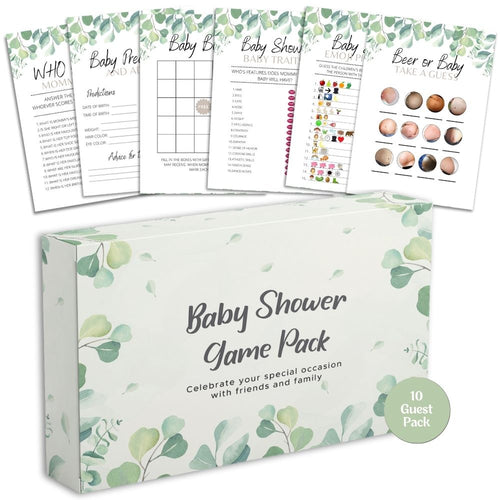
If you are new to the format, read what baby shower games are and how they work. For coordinated ready-made cards, compare our baby shower games collection or view the complete baby shower games pack.


